|

|

|
|
CAPITOL CORNER |
LMTA's Legislative Overview - 2026 Session Wrap Up |
|
|
|
IN THIS ISSUE:
|
|
|
2026 SESSION WRAP UP |
|
|
|
The 2026 Regular Session of the Louisiana Legislature has officially concluded, with lawmakers filing a staggering 2,612 bills. While the volume of legislation was substantial, our review of the session reveals a significant missed opportunity to address some of Louisiana's most pressing business and insurance challenges. Despite years of concern from employers, truckers, and job creators, meaningful reforms aimed at reducing lawsuit abuse and improving Louisiana's costly insurance environment once again faced major hurdles.
For Louisiana's trucking industry, these issues are not theoretical. They directly impact insurance premiums, litigation costs, workforce recruitment, and the overall cost of doing business. Truckers continue to deliver the goods that keep Louisiana moving, yet many of the reforms designed to create a fairer and more predictable legal climate never received a hearing or failed to advance through the legislative process.
That said, LMTA and our industry partners did secure several important victories. Legislation addressing workers' compensation modernization, overweight permit reform, workforce development, and protections against emerging climate-change litigation all advanced through the process and, in many cases, now await final action by the Governor. Likewise, several proposals that would have created additional burdens for motor carriers were successfully defeated or stalled before reaching the Governor's desk.
As we close out the 2026 session, the need for meaningful legal and insurance reform remains clear. Louisiana continues to stand apart from neighboring states in litigation costs, insurance expenses, and workers' compensation outcomes. While progress was made on several fronts, much work remains to ensure our state is competitive, fair, and supportive of the industries that drive our economy.
Renee Amar LMTA Executive Director renee@lmta.la | (225) 287-0117 |
|
|
|
The following recap highlights the key bills LMTA supported, opposed, and monitored throughout the 2026 Legislative Session. * Bills highlighted in yellow were key LMTA bills. |
|
Bills SUPPORTED by the LMTA
LAWSUIT ABUSE BILLS: LAWSUIT ABUSE: HB 95 by Rep Bacala | Real Rates Bill - Would cap recoverable medical expenses in car accident cases to the amount health insurance would have paid if the injured person had insurance but chose not to use it.
* LAWSUIT ABUSE: HB 240 by Rep Chenevert | Transparency in Funding Lawsuits - The bill protects truckers involved in litigation by regulating third-party litigation financing and increasing transparency around these agreements. These agreements are subject to discovery in civil actions, promoting transparency and accountability. Together, these provisions protect truckers from predatory financing practices that could otherwise reduce their financial recovery.
* LAWSUIT ABUSE: HB 437 by Rep Melerine | Expert Witness Transparency - Would have prohibited outcome-based compensation for expert witnesses in litigation while continuing to allow standard payment for their time and professional expertise. The bill would also have strengthened judicial gatekeeping by requiring judges to evaluate an expert’s reliability and neutrality before testimony reaches a jury, aligning Louisiana more closely with widely adopted standards.
* LAWSUIT ABUSE: HB 526 by Rep Dickerson & SB 316 by Sen Mizell | Fair Compensation Limits - HB 526 and SB 316 would cap general damages at $500,000 per claimant, regardless of how many defendants are involved. If a court finds that a claimant has suffered a permanent mental injury that severely limits their ability to work or maintain a reasonable standard of living, the cap increases to $1 million. The bill does not cap damages in the most serious cases. Truckers are voting with their wheels—and right now they’re leaving Louisiana.’ Mississippi and Oklahoma have guardrails. Louisiana doesn’t—and we’re paying the price.’ HB 526 and SB 361 are about jobs, competitiveness, and fairness.’
* LAWSUIT ABUSE: HB 1002 by Rep Carlson | Fair Cash Pay System - Medical expense evidence is limited to the amount an insurance company would have actually paid, rather than the higher sticker-price bills. If a third party buys the medical debt, they can only recover what they paid for it. Claimants are expected to keep medical costs reasonable, and both sides may use experts to argue whether the charges are fair. All medical bills must also be itemized and properly coded.
* LAWSUIT ABUSE: HB 1089 by Rep Bamburg | CARE Account - HB 1089 establishes CARE Accounts, which are court-ordered money market accounts in Louisiana for holding future medical expense awards in certain injury cases. Funds are used only for qualifying medical expenses, and any leftover money reverts to the payor after the plaintiff's death.
OTHER LAWSUIT ABUSE BILLS: HB 804 by Rep Geymann | Louisiana Energy Protection Act - Would protect job creators from climate change lawsuits. A disturbing trend beginning in other states are plaintiffs claiming climate change for the basis of their lawsuit and dragging any number of businesses into the courtroom. Rep Geymann preemptively prevented Louisiana businesses from being exposed to that level of ridiculousness in this state.
HB 118 by Rep Chad Boyer - Proposes a $5,000,000 cap on general damages in delictual actions, which include nonpecuniary damages like pain and suffering. Juries will not be informed of this cap, but courts must reduce awards exceeding the limit. The bill defines "general damages" and "special damages" and clarifies that it does not create new causes of action or alter recoverable damages under the Civil Code.
SB 67 by Sen Morris - Proposes to limit recovery in tort claims for negligent infliction of emotional distress without physical injury. Under the proposed law, recovery requires proof of severe, debilitating, and foreseeable mental anguish or emotional distress, supported by competent medical evidence, caused by the defendant's outrageous conduct and breach of a special, direct duty owed to the plaintiff.
SB 239 by Sen Miller - Establishing that recovery for mental anguish or emotional distress without physical injury requires proof of a genuine and serious likelihood of distress caused by the defendant's conduct. The bill outlines the burden of proof for such claims in tort law.
OTHER IMPORTANT BILLS: HB 658 & 620 by Rep Carlson | Centralized Sales Tax Collection - The bill and Constitutional Amendment.
* PERMITS: HB 746 by Rep Chuck Owen | Overweight Truck Permit Local Government - HB 746 would establish a one-year moratorium so no new local governments can establish local permits for overweight, over height permits. While the moratorium is underway, Rep Schamerhorn filed HCR 53 to study what our surrounding state’s do when it comes to issuing overweight, over height permits.
* WORKFORCE: HB 380 by Rep Travis Johnson: Pilot Program for CDL Program in High School - This bill authorizes LCTCS to establish a pilot program in partnership with a city, parish, or other local public school system. The program aims to increase awareness of and access to training programs related to commercial driver's licenses, entry-level driver training, and transportation, distribution, and logistics.
WORKERS’ COMP BILLS: HB 185 by Rep Melerine - Is a new Louisiana law that changes how independent contractors are defined for workers' compensation purposes. It clarifies that people who mainly do manual labor as independent contractors, as well as their employees who also do manual labor, are covered by workers' compensation.
HB 456 by Rep Chenevert - Will restore employers’ ability to file petitions in the workers’ compensation court and use subpoenas, depositions, and other discovery tools to fully investigate claims. Without this, employers must either pay questionable claims or risk penalties for denying them. It also ensures benefits keep flowing while both sides gather the information needed to resolve disputes fairly.
SB 408 by Sen Myers modernizes the delivery of medical benefits for injured workers by replacing slow, outdated paper systems with modern electronic billing. The bill creates a clearer, data-driven process for setting medical reimbursement rates, so workers get timely care and providers are paid fairly. It also speeds up dispute resolution and reduces costly litigation by strengthening a quick “preliminary determination” process handled by administrative judges. Employers who follow this process get protection from excessive penalties and attorney fees.
|
|
|
|
Bills OPPOSED by the LMTA HB 438 by Rep Ventrella would make it a state crime for truckers to drive without meeting certain federal qualification rules, with fines of $500 for a first offense and $1,000 for later ones. This duplicates existing federal law and creates unnecessary compliance burdens. Adding another layer of regulation is exactly how compliance nightmares begin.
HB 837 by Rep Ventrella adds new liability for damages caused by an unauthorized immigrant, but existing laws already exist. Expanded penalties expose truckers and employers to costly lawsuits over honest hiring mistakes. In today’s legal climate, even small paperwork errors could bring major consequences.
HB 932 by Rep Jordan | Commercial Insurance Market Reform Act - HB 932 drew heavy attention, even though it never got a committee hearing, and many mistakenly thought it was an LMTA bill. We opposed it because it would have taken money from trucking companies with captive insurance to subsidize those without, by charging captive insurers a 3% annual fee on Louisiana trucking premiums. It also imposed strict accident-related disclosure rules with a $5,000 penalty. Overall, it was a bad bill for our members.
HB 1006 by Rep Wilford Carter - Motion for summary judgment- adds five extra days for plaintiffs to oppose a summary judgment motion, but it shortens the time defendants have to review those filings and prepare replies. This tighter window is especially hard on motor carriers dealing with complex cases involving large records and multiple experts. It disrupts the balance of the current process.
HB 1213 by Rep St Blanc | Covered Loads on Trucks - Adding regulations to covered loads for trucks making it more burdensome and confusing to comply with the law.
SB 223 by Sen Luneau - Creates the crime of failure to test for alcohol and controlled substances resulting in serious bodily injury or death.
|
|
|
|
|
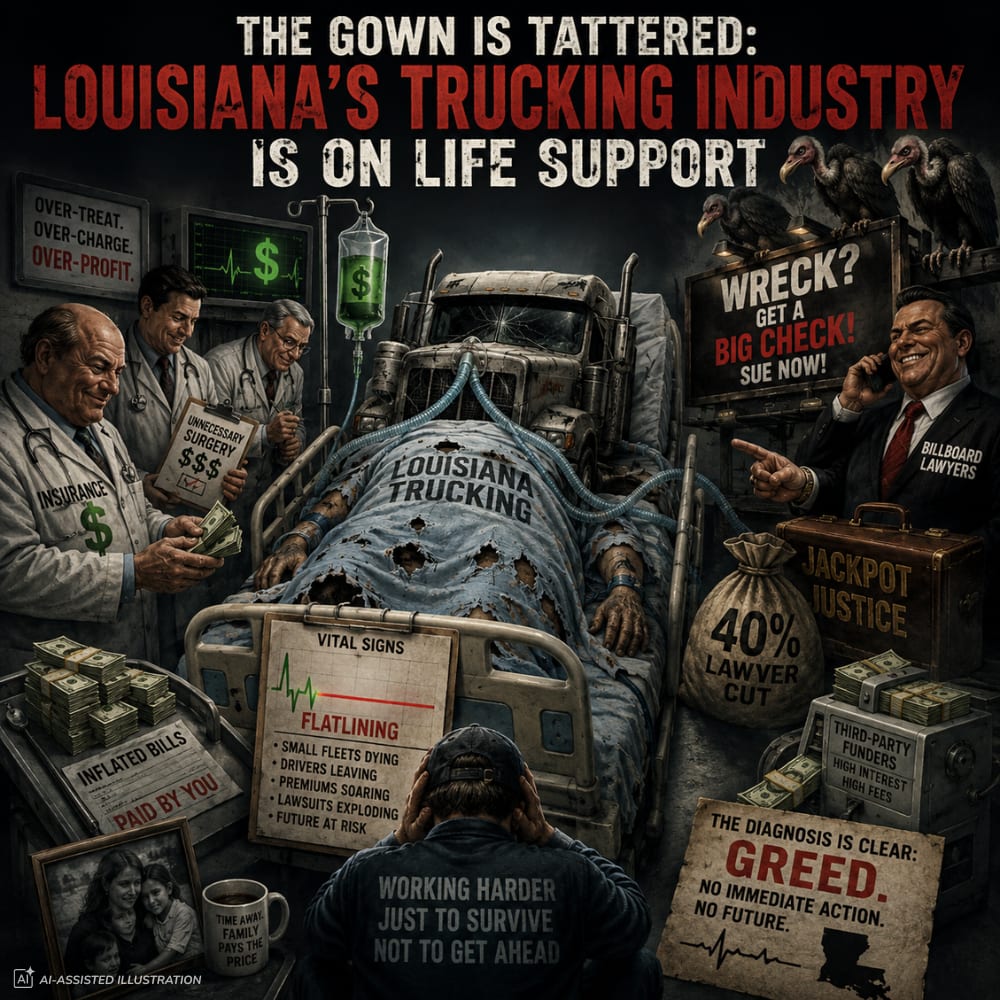
THE GOWN IS TATTERED: LOUISIANA’S TRUCKING INDUSTRY IS ON LIFE SUPPORT: From Executive Director Renee Amar
As I look across the landscape of our industry today, I don’t see the vibrant, humming engine of Louisiana’s economy. I see a patient on a gurney, the heart monitor flatlining while those sworn to protect it argue over who gets to keep the equipment. Our truckers — the backbone of every small business and every household in this state — are withering away, and those in charge are too busy checking their reelection polls to notice the internal bleeding.
We are witnessing the slow, agonizing death of the small-business trucker, suffocated by a system built on unadulterated greed.
The room is crowded with people claiming to “help, ” but their hands are deep in the pockets of an industry already gasping for air. We see clinics and doctors across our state who have traded their Hippocratic oath for a ledger, overtreating and performing unnecessary surgeries, all to squeeze every possible dime out of an insurance policy. It is a predatory cycle that treats human beings like line items.
Towering over this crisis are the vulture billboard lawyers, the architects of a “jackpot justice” culture that has turned our highways into hunting grounds. Their faces are plastered across every mile of interstate, screaming “quick check, sue for a wreck” to anyone who will listen. They are professional scavengers who suck every industry dry until there’s nothing left to bleed. Yesterday, they came for oil and gas; today, they have their sights set on trucking. If they are allowed to finish off the men and women behind the wheel, we have to ask: Who is their target tomorrow? No industry is safe from a business model built on destruction.
This system is designed to ensure that while everyone else gets paid, the actual worker is left with nothing. First, there is the insurance drain — where every inflated settlement and unnecessary surgery comes back around as astronomical premiums that act like a slowacting poison, making it impossible for a small fleet to stay on the road. Then, there is the vanishing payout; by the time the lawyers take their 40 percent and the third-party funders take their high-interest cut, the “injured person ” walks away with a pittance while the middlemen get fat. Finally, we see our drivers dying on the vine, working harder than ever just to pay for the “privilege” of being targeted by this litigation machine. The diagnosis is clear. We must decide if we want a cure or a coroner.
Our politicians offer us thoughts and prayers while they court the very interests that keep this life-support machine unplugged. They care about the optics of the next campaign cycle, not the reality of the empty seats at the dinner tables of our drivers. We are past the point of “monitoring the situation. ” Without immediate, radical intervention to stop the bleeding, the heart of Louisiana trucking will stop beating entirely.
The patient is crashing. It’s time to decide if we’re going to save the life of this industry or just wait for the funeral. |
|
|
|
Staying informed and involved is crucial not just during legislative session, but also throughout the year. If you are not receiving our email updates, please sign up for our Action Alerts. |
|
|
|


